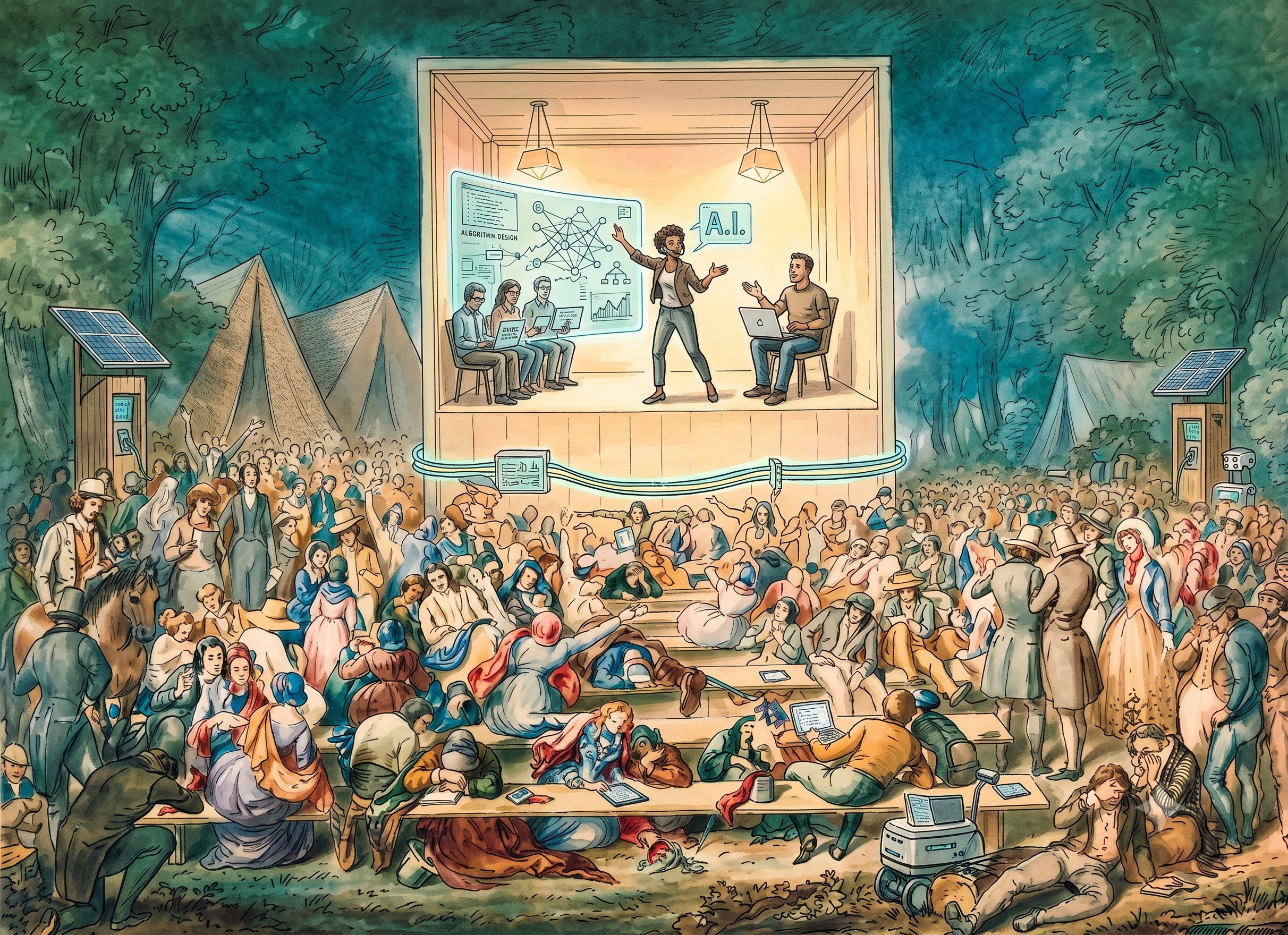
Five hundred years ago, Martin Luther nailed a list of grievances to a church door. His complaint was essentially that the institution had buried the faith under centuries of bureaucracy and toll-collection—indulgences, intermediaries, a whole priesthood standing between the believer and God—and that you could get back to what mattered by cutting all of it away.
The Protestant Reformation did end up addressing many of those grievances. It also did what successful reforms and revolutions tend to do: harden over time into new institutions and new orthodoxies.
So every so often, a new movement appeared, aiming to remind everyone what the whole thing was supposed to be for in the first place. I keep thinking about the Second Great Awakening of the early 1800s: large camp meetings, circuit-riding preachers carrying the message from town to town, new sects emerging, and a notion of restoring a purer form of Christianity. It was not a new religion, at least as they saw it, but rather an insistence on the old one.
Software development is going through a period of upheaval now that has some interesting parallels. The emerging practice of agentic engineering seems very different from agile engineering. As AI changes how software gets built, many believe that the practices of Agile—estimating story points, refining the backlog, ritual meetings—are no longer useful. Some may say that agile is dead. And yet, what I think we are actually seeing is not the death of the old faith but a return to it—a getting back to fundamentals, and a shedding of rituals that no longer serve.
A reformation, then a church
Agile engineering itself is a form of protestantism. Its manifesto, much shorter than Martin Luther’s theses, was directed at the reigning orthodoxy of waterfall: enormous up-front specifications, software built like a bridge whose thousand pages of blueprints must be finished before anyone pours concrete.
The Agile Manifesto famously it doesn’t tell you to do anything but just states preferences: individuals and interactions over processes and tools, working software over comprehensive documentation, and so on. Less ceremony, less mediation, back to the thing that actually matters: working software, in front of real users, as soon as possible.
And then it did what new religions do. Within a few years, “agile” values had become “Agile™️”. There are courses you can take that make you a Certified Scrum Master. There are consultants who will sell you a transformation, not unlike the indulgences that Luther objected to.
But even beyond those who sought the capital-A Agile certifications and such, many more duly tried to follow agile practices without really understanding what it was all for, like going to church and reciting the prayers and expecting spiritual enlightenment to automatically follow. For years I’ve had the nagging sense that a lot of teams perform the rituals of agile—the standups, the backlog refinement, the retrospectives—without ever feeling the spirit behind them, and that getting back to the why would help us ship better software faster. So maybe I’ve been spoiling for a fundamentalist revival for a while. In any case, AI is helping bring it about.
Then code got cheap
A lot of what we used to do in the name of agility is really bookkeeping for a world in which writing code is slow and expensive. We estimate tasks and debate whether something is three story points or five. We track velocity and forecast how much we can take on next sprint from how many points we burned down last sprint. We groom the backlog, ranking every possible thing we might build, and send most of them to the icebox to die. Nearly all of these rituals exist help us best allocate our engineering time, which is our scarcest resource, so that we can avoid expensive mistakes.
Agentic engineering radically changes that calculus. When code is cheap—nearly free—why agonize for a week over whether a feature is worth building when you could just build it in an afternoon and find out? Why maintain an elaborate apparatus to ration a resource that is no longer scarce?
However, most of what we learned about building good software still applies. Solid test coverage was always important, but it’s arguably even more important now because tests are how you keep an eager agent honest. Writing the tests first, as in test-driven development, turns out to be a wonderful way to tell an agent what “done” means. Fast, reliable CI has always been a good thing, and now it’s the guardrail that lets you move at the new speed without flying off the road. Getting working software in front of real users and actually watching what they do is more valuable than ever, because now you can build five things to learn from in the time it used to take to build one—and you don’t have to be precious about prototype code you can cheaply throw away. Observability, testing in production, learning from real usage: all more useful, not less.
Notice what’s on each list. The practices going obsolete are mostly the rituals—the ceremonies of estimation and prioritization that teams perform, often joylessly, without quite remembering why. The practices that survive are the fundamentals—the ones that were always really about tight feedback loops and learning fast. Strip away the bookkeeping of scarcity and what’s left looks a lot like true agility, not productivity theater.
The tells of a revival
The more I thought about the analogy of agentic engineering to the Great Awakenings or other fundamentalist revivals, the more parallels I found.
It’s evangelical
The defining activity of a revival is testimony. You don’t just believe; you tell people. You share your journey, your before-and-after, the night it all changed. The Second Great Awakening ran on exactly this: ordinary people standing up to give witness to their own conversion.
The current AI coding moment has this energy. Everyone has a conversion story, and everyone wants to share it. The good news must be spread.
It requires an epiphany
However, hearing the good news isn’t enough. Being “saved” requires an experience—a conversion, a moment of being born again.
Anyone who is all-in on agentic development will not only tell you that it is revolutionary but also will insist that you can’t understand it without doing it yourself. Dabbling with ChatGPT doesn’t count. Asking it a few questions doesn’t count. There’s a threshold experience—usually something like watching it build something real, end to end, that you’d have budgeted days for—and until you’ve had it, you’re not really a believer. You may think you believe in the power of AI, but you don’t get it until you’ve let Claude into your heart.
No one can explain what it is like to be fully “AI pilled”, as much as we like to talk about our wild experiences with Claude. It’s like hearing about someone’s dreams, or their psychedelic trips: there’s something ineffable. You have to have the epiphany yourself.
It’s a personal relationship
Evangelical Protestantism’s central innovation was the idea of an unmediated, personal relationship with the divine—no priest required, no institution standing between you and God. The Second Great Awakening pushed this even further than the Reformation had: it largely tossed out the old Calvinist predestination, the idea that salvation was decided for you in advance, in favor of the radically democratic notion that anyone could choose to be saved. It was up to you and your own heart.
No one’s AI conversion story is about following a strict process, and certainly not about getting a certification. It’s quite personal: my workflow, my setup, the particular way I talk to the thing. Everyone is vibing up their own agent orchestration, skills, and even harnesses. The value is in your own direct, personal connection to the tools. You have to find your own way to commune with it.
It’s millenarian
The Second Great Awakening was shot through with millennialism: the conviction that history was approaching its appointed climax, that the thousand-year kingdom was at hand. This belief is highly motivating, and it also makes people behave strangely about the future.
William Miller, a Baptist lay preacher, worked out from the prophecies in Daniel that Christ would return around 1843, and then, refined by a follower, on a specific day: October 22, 1844. Tens of thousands of Millerites believed him; some reportedly gave away their possessions to wait. When the day passed and the world stubbornly continued—the “Great Disappointment,” they called it—the movement didn’t dissolve so much as recalculate. Out of the aftermath came new sects that are still with us, the Seventh-day Adventists among them, who drew the sensible lesson that one ought to stop setting dates.
We have our own end-times literature now—AI 2027 and the rest—and we have not yet drawn that lesson. The heads of the big labs have spent years announcing that AGI is coming soon, and then the predictions shift. What’s striking is that the old movement had the same internal split we do: the optimists believed human effort would build the kingdom here on earth, while the pessimists waited for catastrophe to clear the way first. Both camps agree that it’s coming, and soon.
So what’s actually being revived?
Pull back from the agentic-engineering fervor—the testimony, the ineffability, the end-times math—and look at what the converts are actually doing. They’re shipping small things fast, putting working software in front of people constantly, in tight loops, and changing course based on what they see. They need fast yet comprehensive test suites so that the agents can run freely with confidence of not breaking something.
That’s not a new religion. Working software over comprehensive documentation. Responding to change over following a plan. AI has made the fundamental agile bet—that the fastest way to learn is to build something real and get feedback—so cheap that refusing to make it starts to look like a sin.